
China continues to lead the offshore wind sector
The Global Wind Energy Council (GWEC) released its annual offshore wind report on June 15, presenting a highly optimistic outlook for the sector's growth in the coming years. The organization emphasized the important role of offshore wind in ensuring energy security and supporting industrial growth.
71% of new capacity comes from China
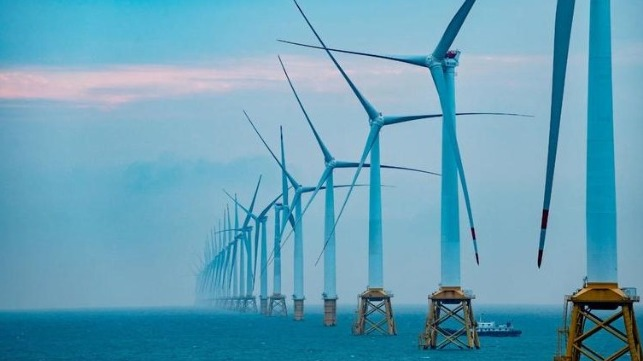
China maintained its leading position for the eighth consecutive year, commissioning 6.6 GW of new offshore wind capacity, equivalent to 71% of the world's newly installed offshore wind capacity. It was followed by the United Kingdom, Taiwan, France, Germany, and South Korea.
By the end of 2025, total global offshore wind capacity reached 92.5 GW, enough to meet the electricity demand of more than 102 million households. China alone accounted for 52.3% of the global total.
According to GWEC, 19 markets have developed offshore wind power, including China, the United Kingdom, Germany, the Netherlands, Taiwan, Denmark, Belgium, France, Vietnam, South Korea, Japan, Sweden, the United States, Norway, Finland, Italy, Portugal, Ireland, and Spain.
One notable highlight is that the average capacity of offshore wind turbines installed in 2025 exceeded 10 MW for the first time, reaching 10.3 MW per turbine. The report did not provide electricity generation data. According to Ember, the entire wind power sector, including both onshore and offshore wind, accounted for 8.5% of global electricity generation in 2025.
Strong growth forecast
GWEC stated that more than 50 GW of offshore wind projects are currently under construction worldwide, while nearly 25 GW of additional capacity is ready for deployment.
The organization forecasts that:
Annual installed capacity will double in 2026.
Annual installed capacity will triple by 2031.
Annual installations will exceed 50 GW per year by 2035.
Over the next 10 years, the world could add more than 327 GW of new offshore wind capacity, bringing total global offshore wind capacity to approximately 420 GW by the end of 2035.
However, GWEC noted that the industry still faces many challenges, particularly slow planning procedures and grid connection processes.
According to GWEC, offshore wind power and the transition to a low-carbon economy are not only climate objectives but also key pillars of energy security and industrial growth.
Rebecca Williams, Deputy CEO of GWEC, said the world needs to accelerate the development of the offshore wind sector in the race to electrify the economy and maximize the deployment of reliable, domestically produced renewable energy before the next crisis occurs.